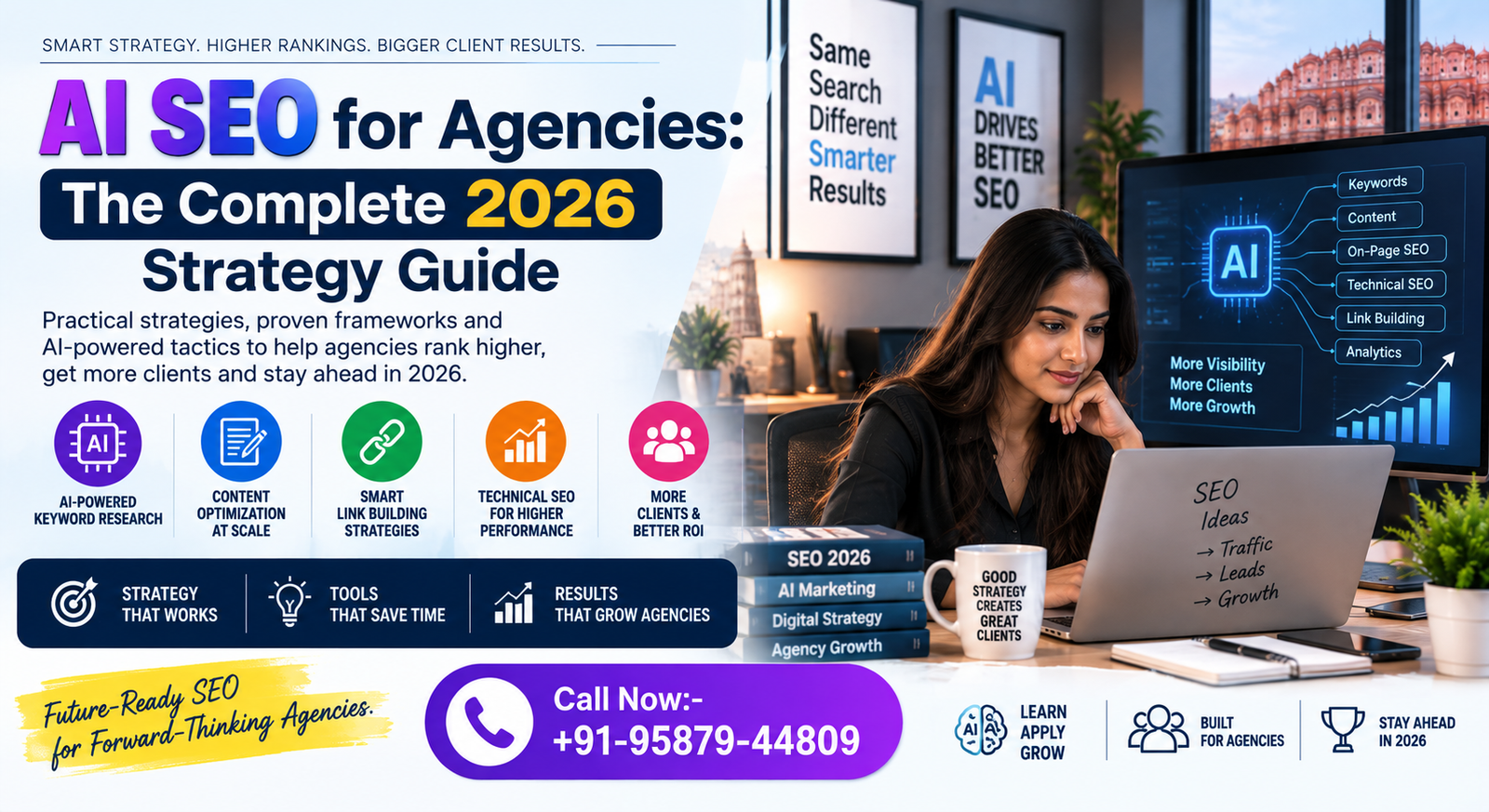
A couple of years ago, running SEO for an agency meant a lot of grinding. Keyword lists in one spreadsheet, competitor notes in another, reporting decks you basically rebuilt from scratch every month. It worked, but it was slow, and honestly a bit painful once you had more than three or four clients on your plate. That’s shifted fast. By 2026 most agencies have AI sitting somewhere in almost every stage of their SEO process, whether they call it that or not.
Here’s where a lot of teams still get it wrong though. AI SEO for Agencies isn’t “type a prompt, publish whatever comes back.” That’s not a strategy — it’s a shortcut, and search engines have gotten uncomfortably good at spotting it. A proper AI SEO strategy uses AI as a research and efficiency layer across keyword research, content planning, technical audits, competitor analysis, and reporting, while an actual human is still the one deciding what goes live and why.
At The Digital Socialite, we spent a good chunk of last year rebuilding our own SEO process around that balance — not chasing automation for its own sake, but figuring out where it genuinely saves time versus where it just creates more editing work later.
What Is AI SEO for Agencies?
Put simply, AI SEO is using AI tools to do the SEO work agencies were already doing, just quicker and with more data to back it up. That covers AI-assisted research, search intent analysis, keyword clustering, content optimization, technical SEO analysis, competitor research, internal linking suggestions, and performance reporting. There’s also a newer piece to it — showing up inside AI search and answer engines like ChatGPT or Google’s AI Overviews, which honestly wasn’t even part of the conversation two years ago.
AI SEO vs Traditional SEO
It’s not really a different goal, it’s a different pace. Here’s roughly how the two compare:
| Traditional SEO | AI-Powered SEO |
| Manual research | AI-assisted research |
| Manual keyword grouping | Automated clustering |
| Manual content analysis | AI-assisted content analysis |
| Manual competitor research | Faster competitive insights |
| Manual reporting | Automated reporting |
None of that replaces an SEO professional, to be clear. AI can cluster a thousand keywords in a few seconds — great. But someone still has to look at that list and decide which of those keywords are actually worth a client’s time and budget.
Why Agencies Need an AI SEO Strategy in 2026
SEO Workloads Are Increasing
Most agencies aren’t running one site anymore. It’s ten, twenty, sometimes a lot more, each with its own calendar, keyword targets, and reporting date. Try doing that by hand across every client and something eventually slips.
Faster Research and Analysis
AI can chew through search data, competitor pages, and keyword lists way faster than a person clicking through tabs. That doesn’t automatically make the research better — it just frees up the hours you’d rather spend actually thinking about strategy.
Better Content Planning
This is one area where AI genuinely earns its keep: spotting intent patterns, mapping out topic clusters, flagging gaps a client’s competitors haven’t touched yet.
Changing Search Behaviour
Google’s AI features, plus the whole shift toward conversational search, mean fewer plain blue-link clicks and more summarized answers up top. Agencies that shrug this off are going to feel it eventually. But so will the ones who chase every AI trend and quietly let the fundamentals slide.
More Efficient Client Reporting
A good AI tool can turn months of performance data into something a client will actually open and read, rather than a 40-tab spreadsheet that sits in their inbox unread.
The Complete AI SEO Workflow for Digital Marketing Agencies
Step 1 — AI-Powered Keyword and Topic Research
Almost every workflow starts here — keyword discovery, intent mapping, topic clusters, long-tail variations, semantic entities, content gaps, the usual list. AI is fast at surfacing patterns in all of that. What it can’t do is confirm they’re right, so every suggestion still needs a check against real search and SEO data before it makes it into a strategy document. Think of it as a first draft, not a final answer.
Step 2 — Competitor and SERP Analysis
Once the keyword list is actually solid, you look at who’s already ranking. Competitor content, how deep those pages go, whether they’re matching search intent well, featured snippets, People Also Ask boxes, gaps in their coverage, backlink opportunities — all of it. This is really what tells you why a competitor is winning, not just that they are.
Step 3 — AI-Assisted Content Strategy
This is a spot where AI is genuinely handy. Content briefs, H2/H3 outlines, FAQ ideas, topic clusters, even a rough content calendar or internal-linking plan — it can get you 60-70% of the way there. It’s a starting point, not something you hand to a client as-is.
Step 4 — Human-Led Content Creation
Of everything on this list, this step matters most. The order should be: AI helps with research, a human writer who actually knows the subject takes it from there, someone fact-checks it, an editor goes through it, and only after all that does it get optimized and published. Content still has to sound like it came from someone who’s done the thing being written about — not like a tidy summary of ten other articles.
Step 5 — On-Page SEO Optimization
Then comes the technical cleanup — title tags, meta descriptions, a proper H1/H2/H3 structure, semantic keywords woven in naturally, internal links, image optimization, schema, clean URLs, and making sure the whole thing is actually readable.
AI SEO for Technical SEO
Website Audit
AI-assisted crawlers pick up crawl issues, broken links, duplicate pages, missing metadata, indexation problems, and other technical mess much faster than someone going page by page manually.
Internal Linking Optimization
It can also scan through a site’s existing content and point out contextual internal-linking opportunities — the kind that are easy to miss once a site has a few hundred pages on it.
Structured Data and Schema
AI can help draft schema markup, sure. But that code needs a developer or SEO specialist to actually validate it before it ships — a broken schema tag can cause more problems than not having one at all.
Core Web Vitals and Technical Performance
It’s decent for reading through performance reports and pointing out patterns worth looking at. Fixing the actual speed or Core Web Vitals issues, though, still comes down to real implementation and testing on a developer’s end.
AI SEO for Content Optimization
Search Intent Optimization
AI can help sort a keyword’s intent into informational, commercial, transactional, or navigational buckets, which honestly changes how a page should be written from the first line.
Content Gap Analysis
Stack a client’s content against what’s already ranking and you’ll usually find missing subtopics, unanswered questions, or angles nobody’s covered yet.
Content Refresh
Rather than writing everything fresh, AI is useful for flagging which existing pages have gone stale, feel thin, or are missing something worth adding back in.
Entity and Semantic SEO
This isn’t about stuffing a keyword in twenty times anymore — it’s about building real depth around related entities and concepts. Keep an eye out for keyword stuffing and generic AI filler here. Search engines are better at catching both than they used to be, and it shows in rankings.
AI SEO and Generative Search: Preparing Websites for AI Search
What Is Generative Search?
This is the AI-driven search experience — Google’s AI Overviews, ChatGPT search, that kind of thing — where the user often gets a summarized answer before they’ve even clicked on a link.
Why Entity and Brand Visibility Matter
Getting pulled into those AI-generated answers usually comes down to a brand having a genuinely clear identity — real expertise, visible author information, business details that check out, some topical authority, and a presence that’s consistent wherever it shows up online.
Optimize Content for Direct Answers
Content that answers the obvious questions directly — what, why, how, when, cost, benefits, how it compares — tends to do better in these AI-driven results than content that dances around the point.
Don’t Abandon Traditional SEO
None of this replaces technical SEO, content quality, or link building. Generative search optimization sits alongside conventional SEO. It doesn’t swap it out.
Best AI Tools Agencies Can Use for SEO
ChatGPT
Handy for content briefs, speeding up early research, helping cluster keywords, and just generating ideas when an SEO workflow needs a starting point.
Google Search Console
Still the most reliable place for real search performance data — queries, pages, click-through rates, indexing status.
Semrush / Ahrefs
Solid for keyword research, competitor analysis, backlink audits, and finding content gaps.
Screaming Frog
The tool most teams reach for on technical crawls — metadata analysis, broken links, indexability checks.
Google Analytics
Where the traffic, engagement, conversion, and user-behaviour numbers actually live.
One thing worth saying plainly: no AI tool directly guarantees Google rankings, no matter what the pricing page promises.
How Agencies Can Automate SEO With AI
Automate Keyword Clustering
Let it group related keywords by intent and topic rather than doing it by hand every time.
Automate Content Brief Creation
A rough brief that writers and SEO teams can build on, generated in minutes instead of an hour.
Automate SEO Reporting
Recurring performance data summarized automatically, so reports take minutes rather than eating an afternoon.
Automate Content Monitoring
Get flagged on pages that need updating before they’ve already started sliding down the rankings.
Automate Repetitive SEO Tasks
Metadata checks, content inventories, sorting URLs, internal-link suggestions, basic technical checks — all reasonable to automate. That said, keep human approval in the loop, particularly on anything that’s going in front of a client.
How to Measure the Success of an AI SEO Strategy
Publishing a lot of AI-assisted content isn’t the metric that matters. What actually matters:
Organic Traffic
Changes in qualified organic traffic, not just how many people showed up.
Keyword Visibility
Rankings and visibility for the keywords that actually move the needle for the business.
Organic Conversions
Leads, enquiries, sales — this tells you a lot more than traffic numbers on their own.
CTR and Search Performance
Search Console will show you whether impressions are actually turning into clicks.
Content Performance
Which pages are pulling their weight, AI-assisted or fully human-written — that’s the real comparison worth making.
AI Search Visibility
Where you can actually track it, keep an eye on brand mentions or citations inside AI search results. Fair warning, the tools for measuring this properly are still catching up, so treat it as something to watch rather than a finished metric.
Common AI SEO Mistakes Agencies Should Avoid
Publishing Mass AI-Generated Content
Pumping out more pages doesn’t mean better rankings. It often means the opposite.
Ignoring Fact-Checking
AI will state something wrong or outdated with total confidence, and it’s easy to miss if nobody’s checking.
Overusing Keywords
Natural language and actual topical relevance beat repeating the same phrase a dozen times, every time.
Removing Human Expertise
Clients are paying for judgment and a strategy behind the work, not just whatever came out of a tool.
Using AI Without a Clear SEO Goal
If an AI workflow isn’t solving a real business or SEO problem, using it just because it exists isn’t a strategy.
Depending on AI-Generated Backlinks or Spam Tactics
Automated or manipulative link building is still one of the quickest ways to wreck a site’s credibility, AI-assisted or not.
AI SEO Strategy for Different Types of Clients
Local Businesses
Local SEO, a solid Google Business Profile, local landing pages, reviews, and getting the local intent right.
E-Commerce Websites
Product content that’s actually useful, well-structured category pages, product schema, matching search intent, and comparison content.
B2B Companies
Expert content, industry-specific topics, case studies, lead generation, and genuine thought leadership — not just recycled industry talking points.
Service Businesses
Strong service pages, FAQs that answer real questions, location pages, and content built around commercial intent and conversions.
AI SEO Checklist for Agencies
- Identify SEO objectives
- Research keywords and search intent
- Analyze competitors
- Build topic clusters
- Create content briefs
- Add human expertise
- Fact-check AI-assisted content
- Optimize on-page SEO
- Improve internal linking
- Monitor technical SEO
- Track organic traffic and conversions
- Review and update content regularly
Read Also:-AI Search Optimization Services: Why Businesses Need More Than Traditional SEO in 2026
FAQs About AI SEO for Agencies
Q.1 What is AI SEO for agencies?
Ans. It’s using AI tools across an agency’s SEO workflow — research, content planning, technical audits, competitor analysis, reporting — to move faster and with better data, while a strategist still makes the final call.
Q.2 Can AI replace SEO professionals?
Ans. Not really. It’s good at speeding up research and clearing repetitive tasks off the plate, but strategy, client judgment, and quality control still need a person who actually knows what they’re doing.
Q.3 Is AI-generated content good for SEO?
Ans. Only once it’s been fact-checked, edited, and shaped by a human. Publishing it raw is one of the quicker ways to hurt a site’s credibility.
Q.4 What are the best AI tools for SEO agencies?
Ans. ChatGPT, Google Search Console, Semrush, Ahrefs, Screaming Frog, and Google Analytics each cover a different piece of the puzzle, from early research through to final reporting.
Q.5 How can AI improve keyword research?
Ans. Mostly by speeding up discovery, clustering, and intent mapping. Every suggestion still needs a sanity check against real search data before it’s used.
Q.6 Can AI help with technical SEO?
Ans. Yes — audits, crawl analysis, spotting internal-linking opportunities, all of that. Actually fixing the issues still comes down to proper implementation.
Q.7 How does AI SEO help with content marketing?
Ans. It handles a lot of the early lift — research, briefs, gap analysis — which makes it easier to plan content that’s actually worth the time to write.
Q.8 What is the difference between AI SEO and traditional SEO?
Ans. Traditional SEO leans on manual research and reporting. AI SEO automates a lot of that same work, but the strategic decisions still sit with a human.
Final Thoughts
AI’s become a genuinely useful part of modern SEO. It’s not a shortcut to rankings though, and agencies that treat it like one usually find that out the hard way, a few months and a ranking drop later. What actually holds up is a mix of AI automation, real SEO expertise, content that’s genuinely original, solid technical work, human judgment, and measuring results consistently instead of guessing.
That’s more or less the approach at The Digital Socialite — using AI to move quicker without losing the strategic thinking that’s the actual reason clients see results. If you’re trying to work out where AI fits into your own SEO strategy without losing sight of what actually works, it’s worth a conversation. You can check out Digital Socialite to see how we’re putting this into practice.